                               ---------
instrument_1 --> effects_1 --> |       |
instrument_2 --> effects_2 --> | mixer | --> music
...                            |       |
instrument_N --> effects_N --> |       |
                               ---------
                    fig.1
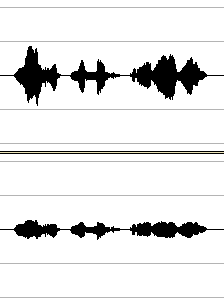
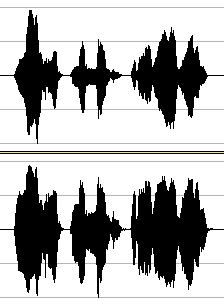
| p.1 |
Compression reduces the difference between the loudnesses of the quietest
and loudest sounds, i.e. the loudness is equalized throughout the soundtrack.
Considering that loudness is associated in the brain with the distance to the sound source: further - quieter, closer - louder, then we can say that the stronger the compression, the closer the sound sources are to each other. Therefore, it is appropriate to introduce the concept of the volume of the sound scene. Compression reduces this volume. |
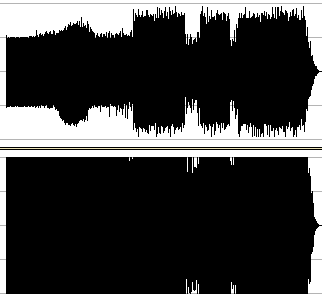
| p.2 | Compression increases the average loudness of a soundtrack (or rather, the average loudness relative to its maximum): a normalized compressed soundtrack sounds louder than a normalized original one. A visual comparison of the soundtracks suggests that they can be compared not only in terms of quieter/louder, but also thinner/denser, weaker/more powerful. |
instrument_i creates a sound that is too uneven in loudness
(this could be, for example, an undesirable fluctuation in the loudness of
the voice depending on the distance between the mouth and the microphone).
In this case, the loudness can be leveled using compression.
instrument_i sounds too weak or
too thin against the background of other instruments and this cannot
be eliminated by simply increasing the loudness,
then compression can also be applied.
                               ---------
instrument_1 --> effects_1 --> |       |
instrument_2 --> effects_2 --> | mixer | --> music --> compression --> compressed
...                            |       |                               music
instrument_N --> effects_N --> |       |
                               ---------