
go up a level

Fight against reflections

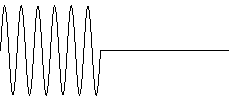
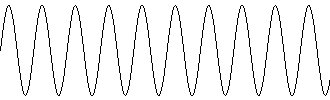
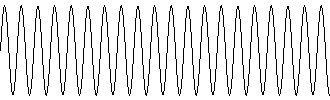
Let there be a loudspeaker and a listener in the room. Let's turn on a fragment of a sinе wave of a certain frequency in the loudspeaker:


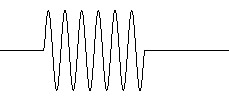
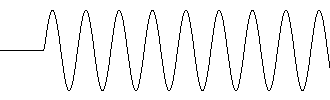
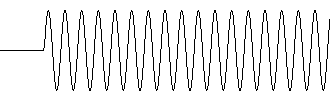
After some time, the sound from the loudspeaker will reach the listener:


This sound is no different from the sound of a loudspeaker, except that it is slightly less loud due to attenuation with distance.

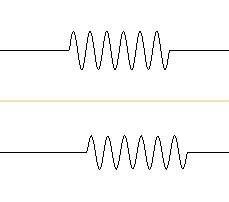
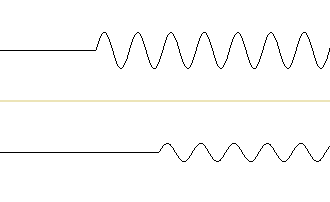
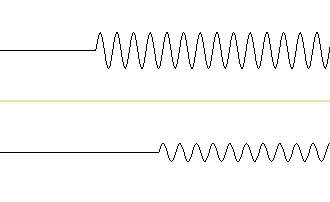
Even later, sounds reflected from the walls, floor and ceiling will begin to reach the listener. For simplicity, let's consider only two reflected sounds:


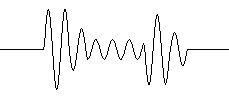
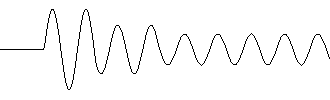
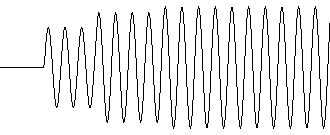
The direct and reflected sounds will be summed up:


Due to reflections, the sound became distorted - it became longer and became contaminated with extraneous components. To imagine the difference between pure sound and sound distorted by reflections, you can compare the sound of clapping your hands in a field and in a room with bare walls. In the first case, the sound will be dull and short, and in the second case - ringing and long.

If the volume of reflected sounds is reduced, then distortion will also be reduced. This can be done by covering the walls and ceiling of the room with sound-absorbing material. As such a material, I chose foam sheets 10 cm thick. (It is possible that a smaller thickness would be sufficient for effective sound absorption. Then the foam sheets could be rolled into rolls for easy transportation.) After covering with foam sheets, clapping by the hands in my room sounds almost the same as in a field - dull and short.

The lower the frequency of sound, the less effective the sound-absorbing materials are. At low frequencies, this does not work. To understand how to deal with reflections at low frequencies, let's conduct the following experiment.

Let's turn on a sine wave of a certain frequency in the loudspeaker:


After some time, the sound from the loudspeaker will reach the listener:


Even later, reflected sounds will begin to reach the listener. For simplicity, let's consider only two reflected sounds:


The direct and reflected sounds will be summed up:


It can be seen that the reflected sounds changed the amplitude of the sound, in this case the amplitude decreased.

Now let's change the frequency of the sine wave in the loudspeaker:


After some time, the sound from the loudspeaker will reach the listener:


It can be seen that the amplitude of direct sound does not depend on frequency.

Even later, reflected sounds will begin to reach the listener. For simplicity, let's consider only two reflected sounds:


The direct and reflected sounds will be summed up:


It can be seen that the reflected sounds again changed the amplitude of the sound, but in this case the amplitude increased. Hence the conclusion: due to reflected sounds, the amplitude changes, the value of this change depends on the frequency; if there were no reflected sounds, the amplitude would not change.

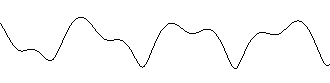
In this case, the dependence of the amplitude on the frequency will be as follows:


Now let's move the loudspeaker to another place and/or let the listener move to another place. Let's repeat the experiment. In order not to clutter this article with pictures, I will immediately give the frequency response:


It is clear that the frequency response is again curved, but the curve is different. Therefore, the shape of the frequency response depends on the locations of the loudspeaker and the listener.

As has already been said, sound-absorbing materials do not work at low frequencies. Therefore, there is nothing else to do but to empirically find such locations for the loudspeakers and the listener (hereinafter referred to as the arrangement), at which the frequency response will be as flat as possible.

Algorithm for finding the best arrangement

1.  Decide on the shape and size of the triangle: left_loudspeaker - right_loudspeaker - listener. I prefer an equilateral triangle with a side of 150 cm.

2.  Move the triangle around the room (if necessary, by turning it). For each arrangement, create an audialy research protocol (see below). By comparing the protocols, choose the best position for the triangle. First, determine the best position with an accuracy of 10 cm, then 5 cm.

3.  If the result is not satisfactory, then change the size and/or shape of the triangle and go to step 2, otherwise finish searching for the best arrangement.

Drawing up a audialy research protocol of the arrangement

Connect a sine wave generator to the loudspeakers and change the frequency from 20 Hz to 200 Hz and back, determine by ear and write down the following in the protocol:

Minimum audible frequency.

Frequencies with volume rises/falls, the magnitude of rises/falls.

Volume change when the listener's head is moved left/right/back/forward/down/up. The head displacement values ​​are selected depending on the listener's mobility (stationary listening, dancing). For frequencies with rises/falls, this point is mandatory, for other frequencies, if necessary.

The right and left ears are at different points in space, so they don't hear exactly the same sound. At some frequencies, a very large phase shift can be detected between the sound on the left and right. This sounds very bad. If such an effect is detected with some arrangement, then that arrangement is not suitable for listening to music. In my case, this effect was observed only at frequencies with volume falls.

* * *

All information in the protocols, except for frequencies, is subjective, i.e. estimated by ear, not measured by instruments, so it may be difficult to choose the best arrangement only by reading the protocols - you may need to quickly change the arrangement and hear the difference directly. You need to change the arrangement quickly, so as not to forget what was heard in the previous arrangement. For a quick change of arrangements, it is convenient to make markings on the floor with masking tape.

* * *

Sound is spoiled by reflections. Reflections are created by walls. Therefore, it is reasonable to choose the center of the room as the initial position of the triangle - away from the walls.

* * *

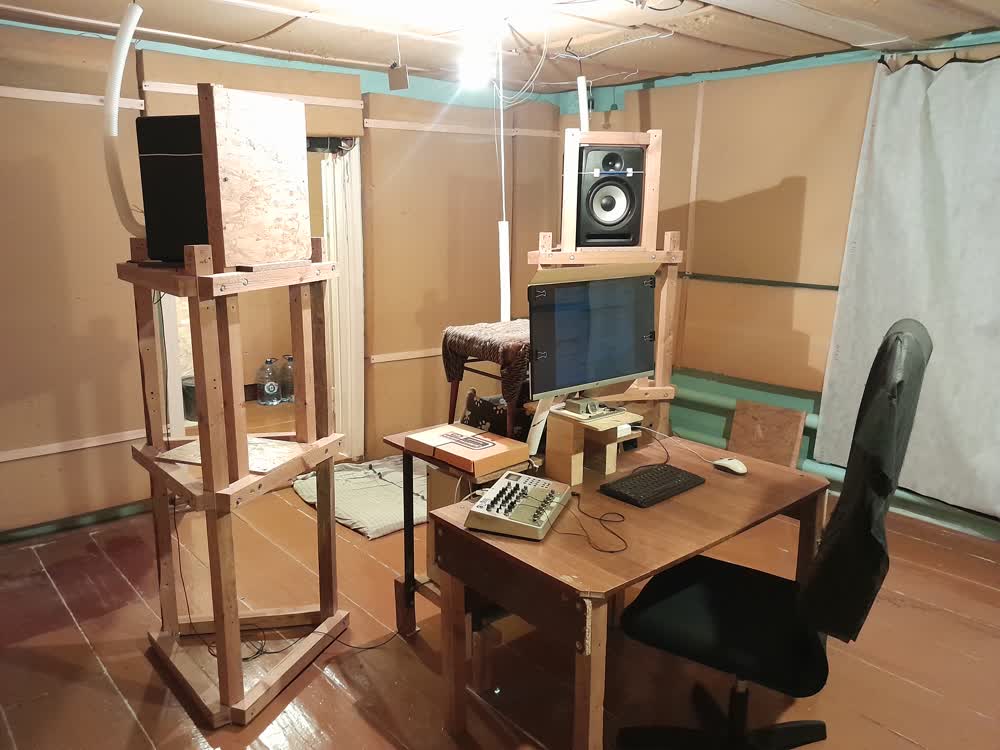
Only direct sound is useful. Sound emitted in other directions is harmful, because it can make reflections. The room probably has door and window openings. It is probably should be better if the loudspeakers S are closer then the listener L to the largest opening (fig. 1), and not vice versa (fig. 2). This will allow more indirect harmful sound to fly out of the room.

-----    ------   -----     -----
|             |   |             |
|   S     S   |   |      L      |
|             |   |             |
|      L      |   |   S     S   |
|             |   |             |
---------------   ---------------
     fig.1             fig.2
* * *

Why do I prefer listening to music through loudspeakers rather than through headphones?

Low-frequency components of sound make surrounding objects vibrate, including the human body. This can be easily verified by placing your palm on any surface - a table, for example. Thus, listening to music through loudspeakers allows you not only to listen to music, but also to feel it tactilely.

* * *

studio